


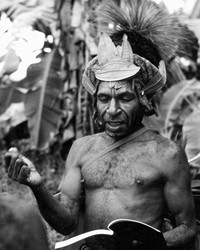

The Wiru people live in the Southern Highlands Province of Papua New Guinea, particularly in the valleys and foothills around the Aseki District near the border with Morobe Province. Their identity is intimately tied to the Wiru language, which belongs to the Papuan Trans-New Guinea family, a broad linguistic grouping that connects many highland communities. The Wiru have long practiced subsistence gardening and maintained clan alliances, with settlement patterns shaped by ridges, rivers, and fertile highland soils that have supported community life across generations.
Wiru daily life is built on extended family and clan cooperation that provides mutual support, care, and shared responsibility. Subsistence agriculture forms the backbone of livelihood, with families tending gardens where sweet potatoes, root crops, and leafy greens are grown for nourishment and local exchange. Traditional labor sharing and reciprocal work strengthen neighborhood ties and reinforce cultural cooperation. Music, dance, and storytelling enrich communal celebrations and mark occasions such as weddings, harvests, and church gatherings. Languages such as Tok Pisin are widely used for schooling, trade, and broader interaction, while the Wiru language remains central in homes and village life.
Christianity is the predominant religious identity among the Wiru, with most people participating in church life and worship. Scripture engagement includes use of portions of the Bible and the New Testament in the Wiru language, as well as audio Scripture resources and translated teaching materials that support both individual and congregational growth. Traditional spiritual ideas related to ancestors and unseen forces continue to influence some cultural interpretation and ceremonial observance, particularly in matters of health and community rites, but the dominant religious framework for many Wiru today is Christian, and church involvement shapes weekly rhythms and moral orientation.
Although Christian identification is widespread, many Wiru believers need deeper biblical discipleship that helps individuals, families, and congregations live out Scripture in everyday life. Local pastors, church teachers, and lay leaders would benefit from ongoing mentoring, structured Bible teaching, and leadership development that equips them to shepherd their congregations and guide discipleship. Family and youth ministries that resonate with cultural identity while grounding believers in scripture will strengthen faith across generations. Because the Wiru church has significant presence in its region, believers are also positioned to engage in gospel outreach and partnership with neighboring peoples who have less access to scripture.
Pray that Wiru believers will grow in a deep and practical love for scripture that shapes their families, decisions, and life together.
Pray for pastors, teachers, and leaders to be equipped with wisdom, compassion, and understanding of God's word as they serve their communities.
Pray for unity, peace, and reconciliation among extended families and clans that reflect Christ's love.
Pray for the youth and young adults to be firmly rooted in faith and active in serving others in Christ's name.
Pray that Wiru Christians will be encouraged and empowered to share the gospel with neighboring peoples who have limited access to scripture.
Scripture Prayers for the Wiru in Papua New Guinea.
https://en.wikipedia.org/wiki/Wiru_language
https://www.ethnologue.com/language/wir
| Profile Source: Joshua Project |


